Pet Life Stages: Understanding Their Age and Appreciating the Time
Compare cat and dog ages with approximate human equivalents, understand each pet life stage, and adapt care while appreciating every season together.

On this page21 sections · tap to navigate
Pet Life Stages: Understanding Their Age and Appreciating the Time
A kitten still looks like a baby at six months, yet is already moving toward adolescence. A one-year-old dog may act playful and unfinished, but is not comparable to a seven-year-old child. A ten-year-old cat can appear unchanged while entering a stage when kidney, thyroid, dental, joint, and blood-pressure problems deserve closer attention.
People often underestimate how much life their companion has already lived because pet aging does not follow a simple human calendar. The familiar rule that one cat or dog year equals seven human years is easy to remember, but biologically misleading. Cats and dogs mature rapidly during their first two years. Later aging differs by species, body size, breed, genetics, health, and lifestyle.
Age equivalents can help people feel the passage of time, but life stages are more useful for care. They remind us that nutrition, behaviour, preventive medicine, mobility, and emotional needs evolve—even when the familiar face at home seems exactly the same.
Why the seven-year rule does not work
Under the seven-year rule, a one-year-old dog would equal a seven-year-old child. In reality, many dogs at one year are sexually mature, near adult size, and moving from puppyhood toward young adulthood. A one-year-old cat is likewise much closer to a young human adult than a child.
The first two pet years account for an especially large amount of development. After that, cats follow a more consistent broad estimate, while dogs diverge by size. Giant dogs generally reach age-associated stages earlier than small dogs.
AAHA's canine life-stage definitions explicitly recommend using age and individual characteristics rather than relying on human-year calculations for clinical care. Size, breed, lifestyle, and health all affect the meaning of a dog's chronological age.
Approximate cat and dog age table
The table below is adapted from an AAHA physiological-age chart. Figures are broad human-age comparisons for communication, not predictions of lifespan or instructions for medical care.
Dog size refers to approximate adult body weight:
- Small: up to 20 lb or 9.1 kg
- Medium: 21–50 lb or 9.5–22.7 kg
- Large: 51–90 lb or 23.1–40.8 kg
- Giant: over 90 lb or 40.8 kg
A dash means the source chart does not provide an estimate for that age and size. It does not mean survival is impossible.
Do not use the table to decide when a pet needs a test, diet, medication, or end-of-life decision. Use the individual pet's clinical condition and veterinary guidance.
Cats: four age-related life stages
The AAHA and FelineVMA feline life-stage guidelines use four age-related stages:
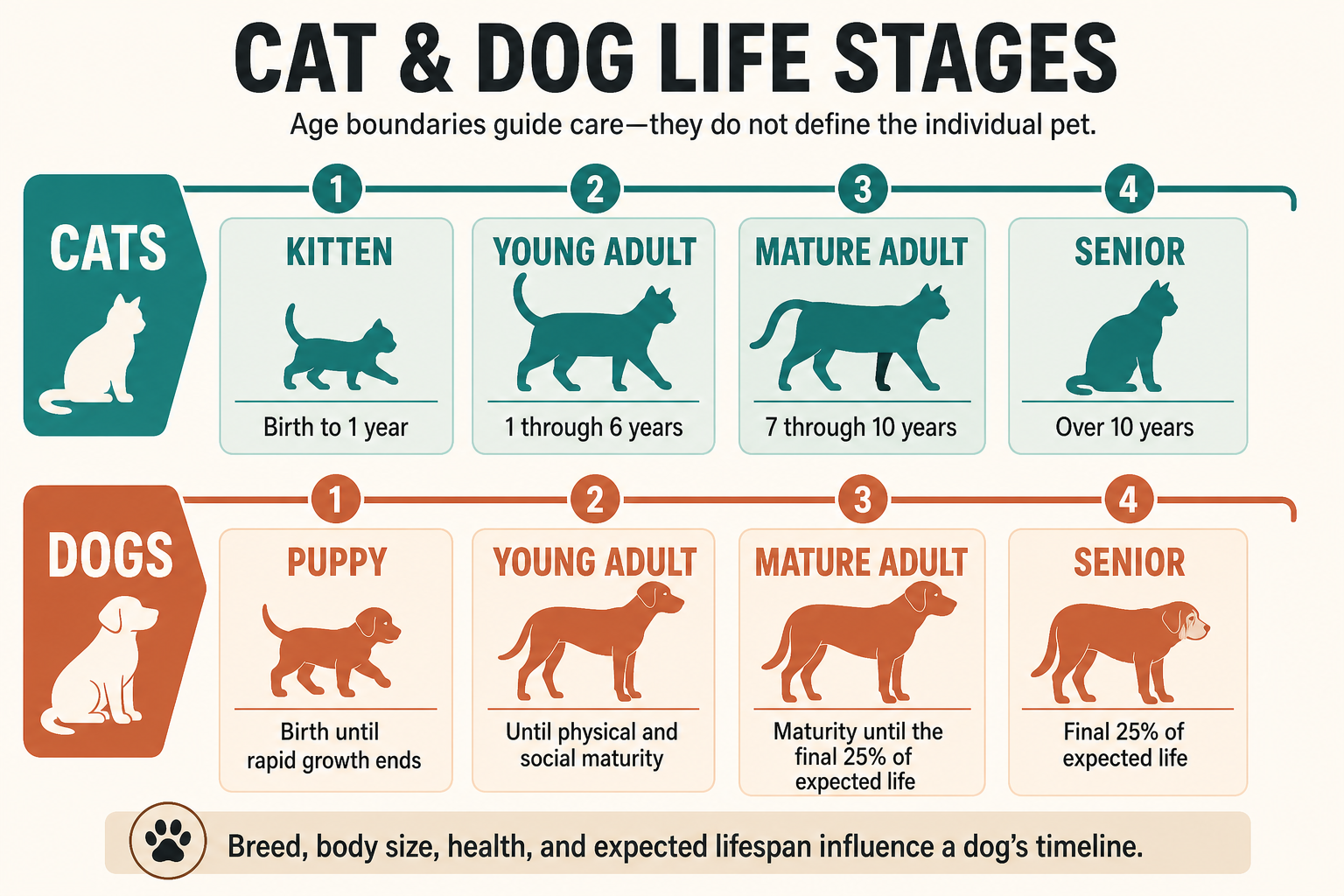
Cat stages use age ranges. A dog's timeline depends more heavily on growth, body size, and expected lifespan.
End of life is a separate stage that can occur at any age because of disease or injury. Age boundaries are useful starting points, not rigid judgments. One eleven-year-old cat may remain athletic and stable while another needs substantial medical and environmental support.
Dogs: life stage depends on expected lifespan
AAHA uses the canine stages summarized in the infographic above. Unlike the feline ranges, the dog timeline depends on development and the proportion of expected lifespan rather than one fixed age for every dog.
This is why a fixed "senior at seven" label is unreliable. A giant-breed dog may enter the final quarter of expected life much earlier than a small dog. Breed-related disease risks, body condition, lifestyle, and health history also matter.
Ask the veterinary team when they consider your dog to be mature or senior and what screening schedule fits that estimate.
Kitten and puppy: life moves quickly
The first year contains extraordinary physical and behavioural change. A tiny dependent animal becomes mobile, social, sexually mature, and close to adult size in a short period.
Important needs include:
- a complete growth diet appropriate for species and expected adult size;
- a veterinary vaccination and parasite-control plan;
- safe, positive social exposure;
- gentle handling and cooperative-care practice;
- toilet or litter habits;
- protected sleep;
- play without using hands as bite toys;
- microchipping and identification;
- discussion of sterilisation timing for the individual.
Socialisation does not mean overwhelming a young animal with everyone and everything. Pair safe novelty with choice, distance, and positive outcomes.
Appreciate this stage without rushing it
People often look forward to the end of chewing, climbing, accidents, and interrupted sleep. Those challenges are real, but the infant stage passes quickly. Take photos and videos, but also put the phone down. Notice the first confident approach, the changing body, and the small routines becoming a shared language.
Do not demand adult self-control from a developing brain. Management and patience are part of the bond.
Young adult: the pet is still developing
A one-year-old cat or dog may look adult while behaviour and social maturity continue to evolve. Dogs in particular may remain adolescent well beyond full height.
Young adults need:
- continued reward-based training;
- appropriate physical and mental activity;
- weight monitoring after growth and sterilisation;
- dental home care;
- stable routines and adequate rest;
- safe outlets for scratching, chewing, climbing, sniffing, hunting, and play;
- ongoing veterinary preventive care.
This is often when novelty becomes less automatically welcome and inherited behaviour tendencies become clearer. A social puppy may become selective with unfamiliar dogs. A cat's relationship with housemate cats may change as everyone matures.
Do not label developmental change as betrayal or stubbornness. Reassess the environment, rule out pain, and update training goals.
Appreciate the ordinary years
Young adulthood can feel like the long middle where birthdays receive less attention. Yet these are often the years of deep routine: the familiar walk, the cat waiting near the desk, the greeting at the door, the bedtime position.
Companionship is made mostly from ordinary days. Do not wait for illness or old age to recognise their value.
Mature adult: prevention becomes more visible
A mature pet may still look and act young. That makes this stage easy to underestimate.
Care priorities include:
- tracking body weight and muscle condition;
- monitoring dental health;
- noticing changes in stamina, jumping, grooming, sleep, appetite, thirst, and toileting;
- reviewing nutrition and calorie needs;
- screening based on species, breed, age, and medical history;
- maintaining play and exercise while adjusting intensity;
- adapting the home before mobility becomes severely limited.
For cats, the mature adult stage begins around seven years. The feline life-stage checklist recommends increased attention to pain, oral health, thyroid and kidney assessment, body condition, and environmental accessibility during mature and senior stages.
For dogs, maturity depends more heavily on expected lifespan. A large dog may need age-focused assessment while a smaller dog of the same chronological age remains earlier in mature adulthood.
Establish a baseline
Record what normal looks like now:
- body weight and veterinary body-condition score;
- how the pet rises, walks, runs, and uses stairs;
- normal water and food intake;
- sleeping and toileting patterns;
- preferred social interaction;
- photographs of body shape from above and the side;
- short videos of normal movement.
A baseline makes gradual change easier to detect.
Senior: older does not mean finished
Senior pets still need pleasure, choice, activity, social contact, and opportunities to use their minds. Aging changes how those needs are delivered; it does not erase them.
Senior care may involve:
- more frequent veterinary examinations and monitoring;
- pain assessment;
- dental, kidney, heart, thyroid, blood-pressure, vision, hearing, and cognitive review as appropriate;
- careful tracking of weight and muscle loss;
- shorter or gentler activity;
- supportive bedding and nonslip flooring;
- ramps, steps, or lower perches selected for the individual;
- low-entry litter trays;
- food and water within an easy route;
- predictable routines and night lighting;
- medication and therapeutic diets when prescribed.
The AAHA senior-patient guidance defines senior cats as over ten and senior dogs by the final 25% of estimated lifespan.
For home adaptations, see Senior-Pet Furniture: Beds, Steps, Ramps, and an Accessible Home.
Do not call every change “old age”
Aging increases risk, but age itself is not a diagnosis. Difficulty rising, house soiling, reduced grooming, irritability, confusion, appetite change, weight loss, and withdrawal may have treatable causes.
Contact a veterinarian rather than assuming nothing can be done. Early support can preserve comfort and familiar activities.
Appreciate without making every moment sad
Knowing time is limited can make people watch a senior anxiously. The pet does not need every quiet day turned into a farewell. They need a comfortable present.
Continue favourite rituals in a form the body can manage. Replace a long hike with a short sniffing route. Lower the cat's window platform. Bring the bed closer to the family. Offer play in smaller bursts. Take the photo, then share the nap.
End of life is a stage, not an age
End-of-life care may become relevant to a very old pet or a young animal with serious disease. It focuses on comfort, dignity, symptom control, meaningful activity, caregiver capacity, and preventing suffering.
A veterinary team can discuss palliative care, hospice, quality-of-life tracking, crisis planning, and humane euthanasia. Planning does not cause the loss. It reduces the chance that a crisis makes every decision at once.
Monitor:
- pain and breathing comfort;
- ability and desire to eat and drink;
- mobility and toileting;
- hygiene;
- rest and sleep;
- social engagement;
- enjoyment of valued activities;
- the balance of comfortable and difficult days.
Seek urgent help for breathing difficulty, collapse, uncontrolled pain, repeated seizures, inability to urinate, severe weakness, or another acute crisis.
Calendar age and biological age are different
Two twelve-year-old cats can have very different bodies. Two eight-year-old dogs of different sizes may be in different life stages. Chronological age is the number of years since birth. Biological or physiological age reflects accumulated changes in organs, mobility, cognition, and resilience.
Factors that influence aging include:
- species, breed, and body size;
- genetics;
- body condition and muscle mass;
- nutrition;
- dental and preventive care;
- chronic disease;
- activity and environment;
- injury history;
- exposure to toxins, infection, and roaming hazards;
- individual variation that cannot be fully predicted.
Human-equivalent tables cannot combine all of these into one number. Use them as perspective, not certainty.
Unknown birth date? Use an estimate with humility
Rescue and adopted pets may have an estimated age based on teeth, eyes, coat, body development, reproductive status, behaviour, and medical findings. Adult estimates often have a wide margin of uncertainty.
Record the estimate and the evidence supporting it, but do not turn an approximate birthday into false precision. Care should follow the current body and health findings.
An adoption anniversary can be celebrated even when the exact birth date is unknown.
Change care before a crisis
At every birthday or adoption anniversary, review:
- Is the current diet still appropriate?
- Has body weight or muscle changed?
- Is the veterinary screening plan current?
- Can the pet reach beds, bowls, litter, and favourite places comfortably?
- Has play, sleep, social behaviour, or toileting changed?
- Are microchip and contact details current?
- Does the emergency plan still work?
- What does the pet enjoy most now?
Small annual adjustments prevent the home and routine from becoming outdated around an aging animal.
A life-stage care table
| Stage | What the pet may need most | What the person should notice | | --------------- | ------------------------------------------------------------------------ | ----------------------------------------------------------------------------------- | | Kitten or puppy | Growth nutrition, safety, sleep, socialisation, preventive care | Rapid development, fear periods, chewing, play, toilet learning | | Young adult | Continued training, healthy weight, activity, stable routines | Social maturity, calorie needs, dental health, emerging preferences | | Mature adult | Screening, muscle and weight monitoring, sustainable exercise | Gradual mobility, appetite, thirst, grooming, sleep, and behaviour changes | | Senior | Comfort, accessibility, pain care, closer monitoring, adapted enrichment | Stiffness, confusion, sensory change, muscle loss, altered toileting or interaction | | End of life | Symptom relief, dignity, meaningful connection, crisis planning | Comfort, breathing, eating, mobility, hygiene, enjoyment, good and difficult days |
The table is a conversation starter. Veterinary recommendations must be individualised.
Ways to appreciate the companion now
Appreciation does not require a dramatic bucket list. Many animals value familiarity more than novelty.
Try:
- learning the pet's favourite form of attention;
- preserving one shared ritual even during busy weeks;
- taking occasional movement videos as both memories and health baselines;
- letting a dog sniff instead of rushing every walk;
- sitting near a cat without requiring touch;
- offering age-appropriate play;
- visiting a familiar safe place;
- recording small habits you never want to forget;
- making the home easier before the pet has to ask;
- arranging veterinary care while problems are still manageable.
Do not postpone kindness until the pet is visibly old. The young, energetic years are finite too.
Avoid turning age into limitation
A senior label should increase support, not erase individuality. Do not stop all play, training, travel, or exploration merely because of a birthday. Ask what remains safe and enjoyable.
Likewise, do not push activity to prove the pet is "still young." Watch recovery, breathing, gait, willingness, temperature, and veterinary restrictions.
The right activity respects both capacity and desire.
The practical takeaway
Pet aging is not seven human years for every calendar year. Cats and dogs mature rapidly at first, and dogs diverge later according to size, breed, and expected lifespan. Human equivalents can make time easier to imagine, but clinical life stages should guide care.
Learn the stage, then look at the individual. Update nutrition, veterinary screening, activity, home access, and expectations as the body changes. Notice gradual shifts before they become emergencies.
Most importantly, do not let the age table create only sadness. Let it create attention. The companion beside you experiences life in meals, walks, naps, play, familiar voices, and safe presence. Their timeline may move faster than ours, but that makes the ordinary time together more valuable—not less.
For related guidance, read Annual Health Checklist for Dogs and Cats, Cats Need Attention Too, and Love the Pet in Front of You.
Common questions
Is one dog or cat year equal to seven human years?
No. Cats and dogs mature very quickly in their first two years, and dogs age at different later rates depending partly on their size, breed, health, and expected lifespan.
When is a cat considered senior?
AAHA and FelineVMA life-stage guidance defines cats over 10 years old as senior, while recognising that individual condition varies.
When is a dog considered senior?
AAHA defines a senior dog as one in the final 25 percent of its estimated lifespan, so large and shorter-lived breeds generally enter the senior stage earlier than smaller dogs.
